Climatological Resilience and Sustainable Urbanism: An Analytical Blueprint for Nagpur’s Real Estate Transformation

Nagpur, located at 21° 41' N to 20° 35' N and 78° 15' E to 79° 45' E, serves as a primary logistical and industrial node at an elevation of 312.4 meters. For investors and residents, the city's value is increasingly tied to its ability to mitigate extreme thermal variability and the Urban Heat Island (UHI) effect.

Mitigating thermal variability through sustainable design

1. Climatological Data and Seasonal Thermal Fluctuations

Nagpur’s climate is characterized by a high thermal peak in summer and significant variability in nocturnal cooling. Climatological data from 1961 to 2020 confirms a rising trend in heatwave frequency, with durations increasing by 0.44 days per decade.

Seasonal Temperature and Rainfall Benchmarks

Month Avg Max Temp (∘C) Avg Min Temp (∘C) Extreme Max (∘C) Avg Rainfall (mm)
May (Peak) 42.7 27.8 47.6 18.2
June 37.8 26.4 47.7 163.4
August 30.6 23.7 37.6 275.0
December 28.6 12.6 34.0 12.6

Sources: IMD Historical Data (1969-2010).

Annual precipitation averages between 1,100 mm and 1,200 mm, with roughly 90% concentrated during the monsoon (June–September). For residents, the "perceived" temperature (Heat Index) remains a critical metric, as humidity often prevents effective evaporative cooling post-monsoon.

2. Industrial Carbon Intensity and the Urban Heat Island (UHI)

The rapid expansion of Nagpur’s industrial and building sectors has created a distinct micro-climatic disparity. In densely built areas, temperatures are recorded 4°C to 5°C higher than in adjacent green zones within the same geographical region.

Key Emissions and Thermal Data:

  • Building Sector Impact: Residential, commercial, and institutional buildings account for 58% of Nagpur’s energy consumption and 56% of its Greenhouse Gas (GHG) emissions.
  • Industrial Pollutants: Major power plants like Koradi generate approximately 7,822 MT of fly ash daily, contributing to particulate matter (PM2.5) levels that can exceed 130 µg/m³, significantly higher than WHO safety guidelines.
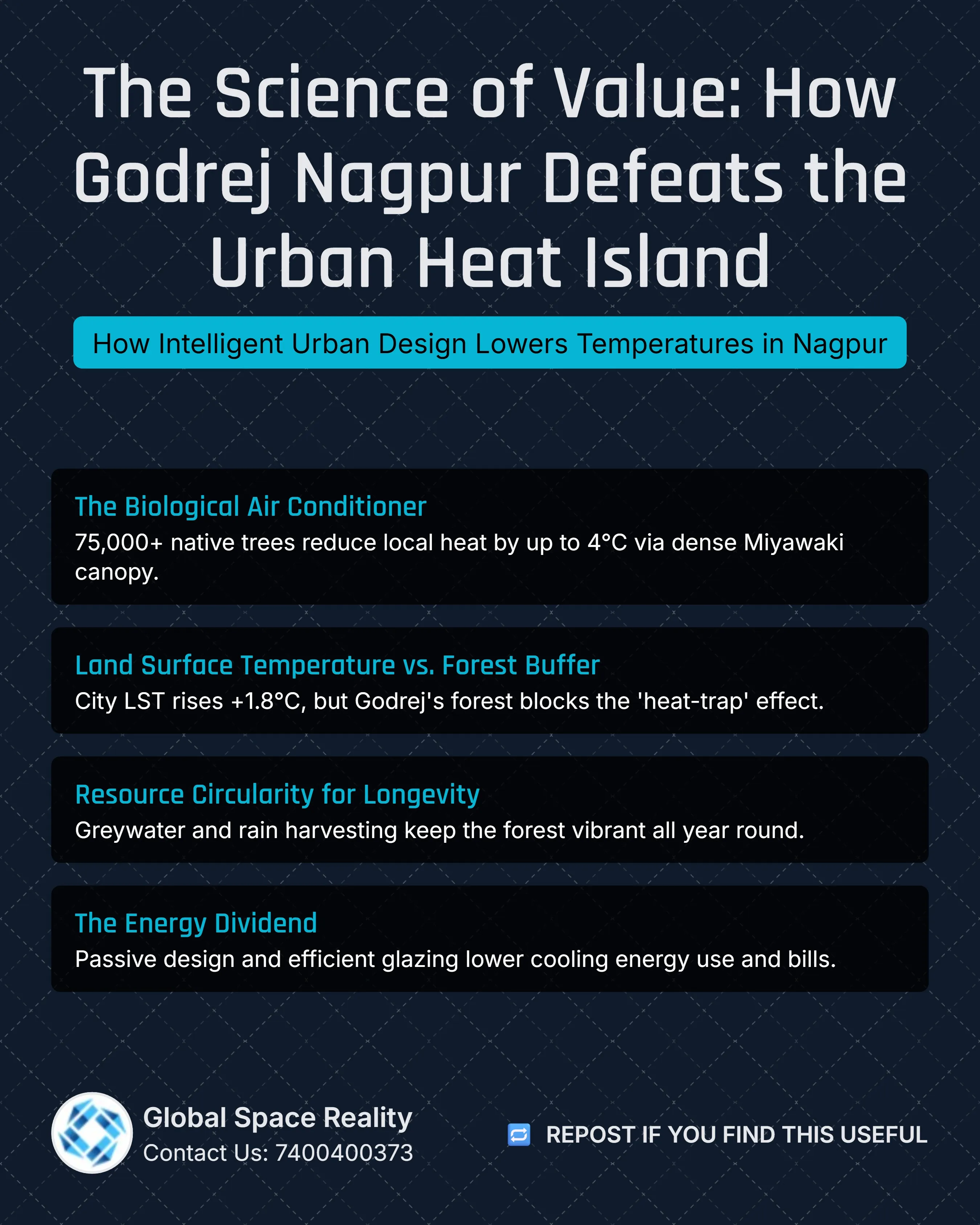
  • LST Increase: Land Surface Temperature (LST) in urbanized areas has increased by approximately 1.33°C to 1.8°C over the last two decades as vegetation cover dropped by 18%.

Miyawaki forests: The Godrej answer to UHI

3. Government Policy and Decarbonization Targets

Nagpur has operationalized the Zero Carbon Buildings Action Plan (ZCBAP), the first of its kind in India, targeting net-zero carbon emissions for all building types by 2050.

  • Net Zero 2030: Mandates that all new constructions achieve net-zero carbon status by 2030.
  • Smart Mobility Plan: A ₹25,567 crore investment into eco-friendly transport, including Phase 2 of the Nagpur Metro.
  • Miyawaki Urban Forestry: Systematic conversion of barren urban lands into dense micro-forests, which grow 10 times faster and are 30 times denser than traditional plantations.

4. The Godrej Paradigm: Climate Mitigation and Asset Value

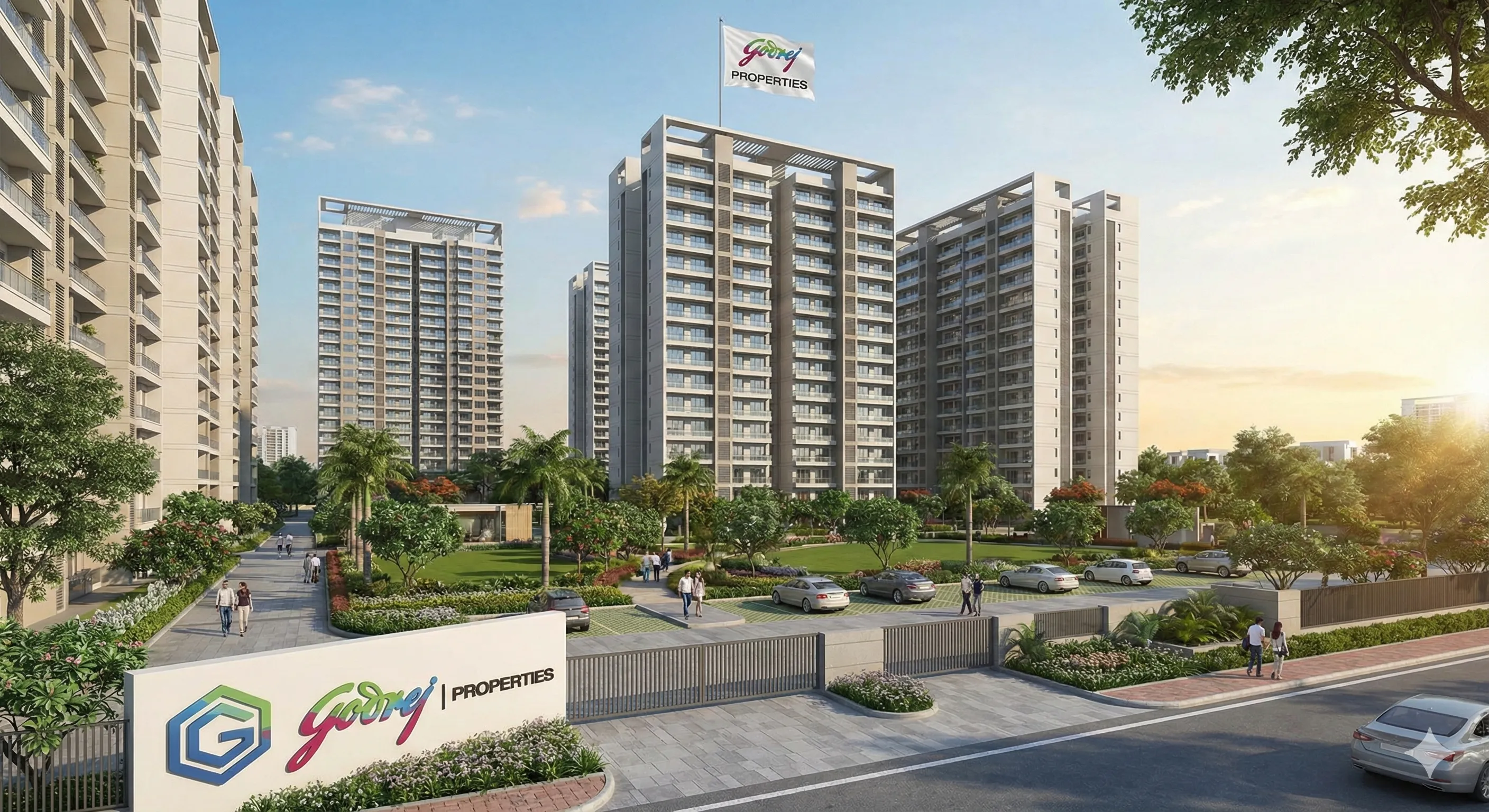
In response to these thermal challenges, Godrej Properties has implemented a "Forest Living" model at its Nagpur estates (Godrej Forest Estate and Orchard Estate). These projects function as climatic buffers for residents and high-value assets for commercial owners.

Numerical Mitigation Metrics at Godrej Nagpur:

  • Biological Cooling: Over 75,000 native trees have been planted using the Miyawaki method, creating a dense canopy that reduces local ambient temperatures by up to 4°C.
  • Ecosystem Services: The project includes a 13-acre dedicated forest reserve and 5.26 hectares of open green spaces (approx. 13.5% of the total project area).
  • Resource Circularity: Integrated Rainwater Harvesting (RWH) and a dedicated Sewage Treatment Plant (STP) ensure 100% recycling of greywater for landscaping, vital for maintaining the 75,000-tree forest during dry summers.
  • Passive Architecture: Utilization of high-performance glazing and shaded pathways reduces building heat gain, cutting cooling-related energy costs for residents and commercial units.

5. Investment Analytics: The "Green Premium"

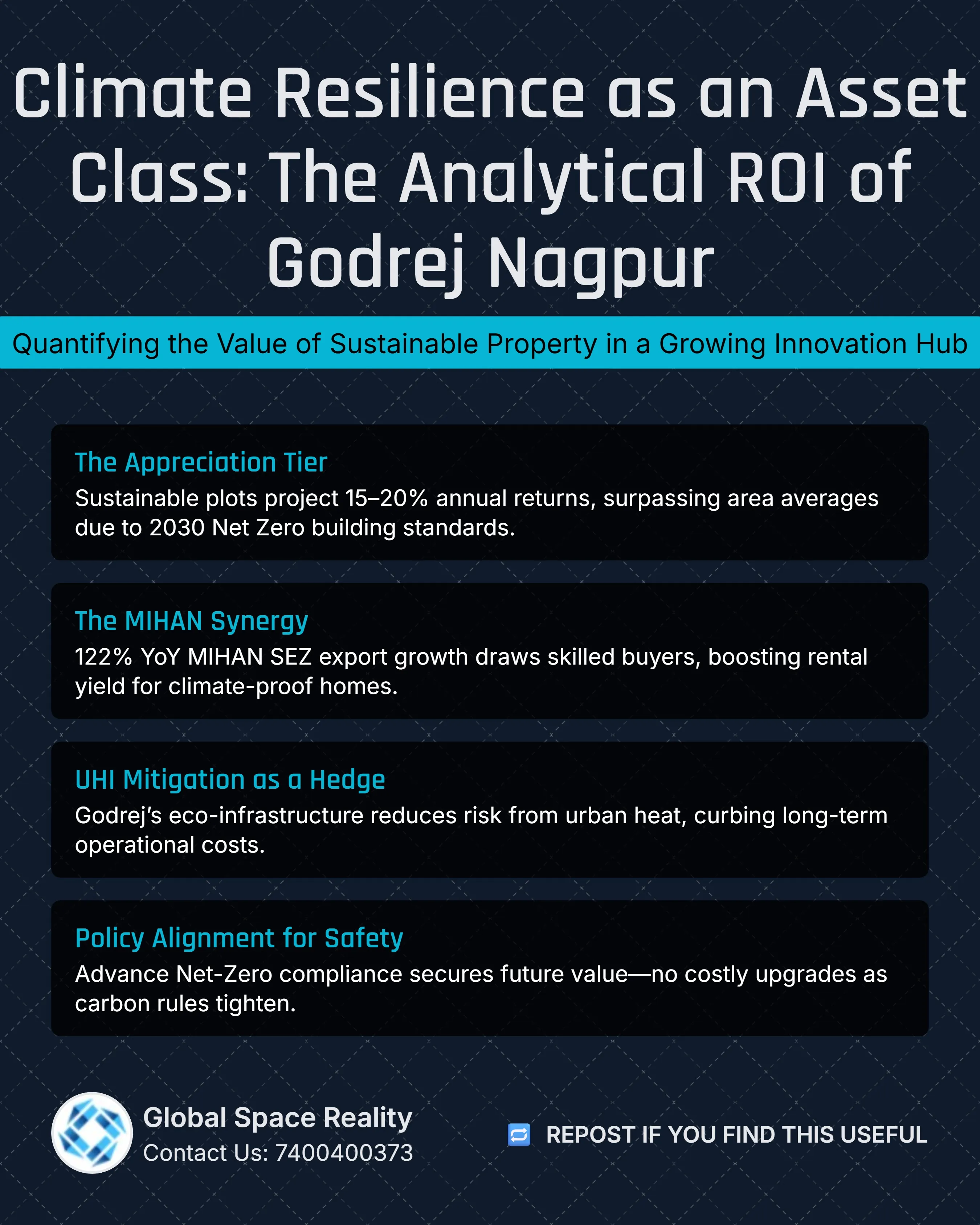
For commercial plot owners, climate resilience is a direct driver of ROI. Data indicates that properties in "green-certified" or "forest-themed" enclaves in Nagpur are witnessing faster appreciation than standard urban plots.

Metric Hingna / MIHAN Corridor Godrej Nagpur (Projected)
Annual Price Appreciation 8% – 15% 15% – 20% (Sustainable Tier)
3-Year Regional Appreciation 58.2% (Hingna Belt)
Rental Yield Potential ₹15,000 – ₹17,000/month High (Premium Demand)

*Source: Kinfra, Housing.com, and local market trends (2025).

Conclusion

Proximity to the MIHAN SEZ—where exports reached ₹3,961 crore in FY25 (a 122% YoY increase)—ensures a steady influx of high-skill professionals. These professionals increasingly prioritize "climate-proof" housing, creating a resilient demand for Godrej's sustainable infrastructure.

Invest in Climate-Resilient Real Estate

Secure your plot in Nagpur's only forest-themed township. Experience cooler temperatures and higher appreciation.

Explore Forest Estate
Call Now WhatsApp
WhatsApp Climatological Resilience & Sustainable Urbanism: Nagpur Real Estate Analysis

Climatological Resilience and Sustainable Urbanism: An Analytical Blueprint for Nagpur’s Real Estate Transformation

Nagpur, located at 21° 41' N to 20° 35' N and 78° 15' E to 79° 45' E, serves as a primary logistical and industrial node at an elevation of 312.4 meters. For investors and residents, the city's value is increasingly tied to its ability to mitigate extreme thermal variability and the Urban Heat Island (UHI) effect.

Mitigating thermal variability through sustainable design

1. Climatological Data and Seasonal Thermal Fluctuations

Nagpur’s climate is characterized by a high thermal peak in summer and significant variability in nocturnal cooling. Climatological data from 1961 to 2020 confirms a rising trend in heatwave frequency, with durations increasing by 0.44 days per decade.

Seasonal Temperature and Rainfall Benchmarks

Month Avg Max Temp (∘C) Avg Min Temp (∘C) Extreme Max (∘C) Avg Rainfall (mm)
May (Peak) 42.7 27.8 47.6 18.2
June 37.8 26.4 47.7 163.4
August 30.6 23.7 37.6 275.0
December 28.6 12.6 34.0 12.6

Sources: IMD Historical Data (1969-2010).

Annual precipitation averages between 1,100 mm and 1,200 mm, with roughly 90% concentrated during the monsoon (June–September). For residents, the "perceived" temperature (Heat Index) remains a critical metric, as humidity often prevents effective evaporative cooling post-monsoon.

2. Industrial Carbon Intensity and the Urban Heat Island (UHI)

The rapid expansion of Nagpur’s industrial and building sectors has created a distinct micro-climatic disparity. In densely built areas, temperatures are recorded 4°C to 5°C higher than in adjacent green zones within the same geographical region.

Key Emissions and Thermal Data:

  • Building Sector Impact: Residential, commercial, and institutional buildings account for 58% of Nagpur’s energy consumption and 56% of its Greenhouse Gas (GHG) emissions.
  • Industrial Pollutants: Major power plants like Koradi generate approximately 7,822 MT of fly ash daily, contributing to particulate matter (PM2.5) levels that can exceed 130 µg/m³, significantly higher than WHO safety guidelines.
  • LST Increase: Land Surface Temperature (LST) in urbanized areas has increased by approximately 1.33°C to 1.8°C over the last two decades as vegetation cover dropped by 18%.

Miyawaki forests: The Godrej answer to UHI

3. Government Policy and Decarbonization Targets

Nagpur has operationalized the Zero Carbon Buildings Action Plan (ZCBAP), the first of its kind in India, targeting net-zero carbon emissions for all building types by 2050.

  • Net Zero 2030: Mandates that all new constructions achieve net-zero carbon status by 2030.
  • Smart Mobility Plan: A ₹25,567 crore investment into eco-friendly transport, including Phase 2 of the Nagpur Metro.
  • Miyawaki Urban Forestry: Systematic conversion of barren urban lands into dense micro-forests, which grow 10 times faster and are 30 times denser than traditional plantations.

4. The Godrej Paradigm: Climate Mitigation and Asset Value

In response to these thermal challenges, Godrej Properties has implemented a "Forest Living" model at its Nagpur estates (Godrej Forest Estate and Orchard Estate). These projects function as climatic buffers for residents and high-value assets for commercial owners.

Numerical Mitigation Metrics at Godrej Nagpur:

  • Biological Cooling: Over 75,000 native trees have been planted using the Miyawaki method, creating a dense canopy that reduces local ambient temperatures by up to 4°C.
  • Ecosystem Services: The project includes a 13-acre dedicated forest reserve and 5.26 hectares of open green spaces (approx. 13.5% of the total project area).
  • Resource Circularity: Integrated Rainwater Harvesting (RWH) and a dedicated Sewage Treatment Plant (STP) ensure 100% recycling of greywater for landscaping, vital for maintaining the 75,000-tree forest during dry summers.
  • Passive Architecture: Utilization of high-performance glazing and shaded pathways reduces building heat gain, cutting cooling-related energy costs for residents and commercial units.

5. Investment Analytics: The "Green Premium"

For commercial plot owners, climate resilience is a direct driver of ROI. Data indicates that properties in "green-certified" or "forest-themed" enclaves in Nagpur are witnessing faster appreciation than standard urban plots.

Metric Hingna / MIHAN Corridor Godrej Nagpur (Projected)
Annual Price Appreciation 8% – 15% 15% – 20% (Sustainable Tier)
3-Year Regional Appreciation 58.2% (Hingna Belt)
Rental Yield Potential ₹15,000 – ₹17,000/month High (Premium Demand)

*Source: Kinfra, Housing.com, and local market trends (2025).

Conclusion

Proximity to the MIHAN SEZ—where exports reached ₹3,961 crore in FY25 (a 122% YoY increase)—ensures a steady influx of high-skill professionals. These professionals increasingly prioritize "climate-proof" housing, creating a resilient demand for Godrej's sustainable infrastructure.

Invest in Climate-Resilient Real Estate

Secure your plot in Nagpur's only forest-themed township. Experience cooler temperatures and higher appreciation.

Explore Forest Estate
Call Now WhatsApp
WhatsApp